Aging Out, by Lucy Schiller
- Get link
- X
- Other Apps
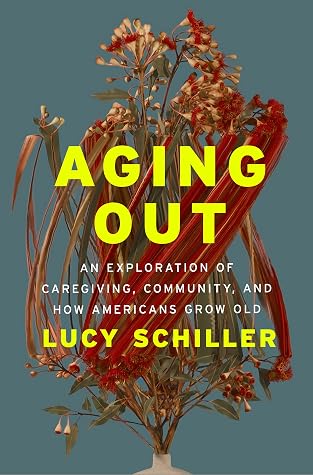
Aging Out: An Exploration of Caregiving, Community, and How Americans Grow Old
by

by
This is a memoir by an author who is a thirty-something from the millennial generation who is keenly observing the consequences of growing old, and the variety of ways older people are treated and cared for. She has recently experienced the death of one grandparent and helped care for the other grandparent. These experiences have prodded her into exploring the subject of eldercare and growing old in America. But this book remains very much a memoir, and at least half of its narrative is addressing her own feelings, circumstances, and experiences. Thus once we finish this book we know as much about her as we do older people.
Which make we wonder who the intended reading audience happens to be. Are her fellow millennials the targets or people who are already old? It's clear to me that it's the millennials who could profit the most from reading this book since it might inspire them to plan ahead and perhaps save more for their later years. However it is my guess that most of the readers will be boomers who are curious to compare their circumstances with those of their generational cohorts.
Readers of the book will learn early in the book what we already know—it helps to have money. People who are able to pay for the level of care and independence that they want and need can have reasonable expectations of living pleasant and happy older years. However, the prospects for those who will be depending on government assistance have fewer and less desirable options—in some cases very unpleasant options. Some people assume that Medicare will help pay for nursing home care (it doesn't). Medicaid for the indigent (and those who "spend down" their resources to qualify) can pay for nursing home care, but options are limited and quality less assured.
There's a chapter on the history of Medicare which I think would be very educational for everyone to read. Its first proposed concept under the Truman administration was to pay for everyone's medical care. Private business interests killed that idea, so by the time it finally passed under the Johnson administration it was limited to those over age sixty-five. However, its coverage was so limited that it left room for private insurance to remain involved. Insurers soon offered, to those who could afford it, Medigap insurance (a.k.a. Medicare Supplement Plans). Then the private insurance business lobbied themselves into being allowed to offer Advantage Plans. Then it was expanded to offer pharmacy insurance which came through private insurers.
The book also includes discussion of friendly visitor programs that are subsidized by insurance companies to help fight the loneliness epidemic. Ironically, polling shows that younger people report being lonely at a higher rate than older people. The author reports on her experiences being a visitor in one such program.
The book also discusses PACE (Program of All-Inclusive Care for the Elderly) which is a Medicare and Medicaid program that provides comprehensive medical and social services to help frail older adults live safely in their community instead of a nursing home. My daughter used to work for On Lok which is a PACE program in San Francisco.
There's also a chapter on the history of the Gray Panthers and another chapter on the history of the American Association of Retired People (AARP).
The following are some excerpts taken from near the end of the book:
Which make we wonder who the intended reading audience happens to be. Are her fellow millennials the targets or people who are already old? It's clear to me that it's the millennials who could profit the most from reading this book since it might inspire them to plan ahead and perhaps save more for their later years. However it is my guess that most of the readers will be boomers who are curious to compare their circumstances with those of their generational cohorts.
Readers of the book will learn early in the book what we already know—it helps to have money. People who are able to pay for the level of care and independence that they want and need can have reasonable expectations of living pleasant and happy older years. However, the prospects for those who will be depending on government assistance have fewer and less desirable options—in some cases very unpleasant options. Some people assume that Medicare will help pay for nursing home care (it doesn't). Medicaid for the indigent (and those who "spend down" their resources to qualify) can pay for nursing home care, but options are limited and quality less assured.
There's a chapter on the history of Medicare which I think would be very educational for everyone to read. Its first proposed concept under the Truman administration was to pay for everyone's medical care. Private business interests killed that idea, so by the time it finally passed under the Johnson administration it was limited to those over age sixty-five. However, its coverage was so limited that it left room for private insurance to remain involved. Insurers soon offered, to those who could afford it, Medigap insurance (a.k.a. Medicare Supplement Plans). Then the private insurance business lobbied themselves into being allowed to offer Advantage Plans. Then it was expanded to offer pharmacy insurance which came through private insurers.
The book also includes discussion of friendly visitor programs that are subsidized by insurance companies to help fight the loneliness epidemic. Ironically, polling shows that younger people report being lonely at a higher rate than older people. The author reports on her experiences being a visitor in one such program.
The book also discusses PACE (Program of All-Inclusive Care for the Elderly) which is a Medicare and Medicaid program that provides comprehensive medical and social services to help frail older adults live safely in their community instead of a nursing home. My daughter used to work for On Lok which is a PACE program in San Francisco.
There's also a chapter on the history of the Gray Panthers and another chapter on the history of the American Association of Retired People (AARP).
The following are some excerpts taken from near the end of the book:
Linear time is how many of us think about aging. After all, you start young and healthy, you end decades later in a frizz of ailments ... If we were to think with linearity, the future of growing old did not look great. I did not feel, honestly, that great or good news sat ahead of us. It was not possible for me to imagine a solution to the level of fragmentation, pain, and dysfunction I saw in my research and around me. It was very possible to feel a deep despair about the future, and what it might look like for those of us currently in our 20s, 30s, or 40s. ...
... The changes that were happening were years, even decades in the making. The holes, for instance, built into Medicare, which have allowed private insurance companies to fill them. Or stepping further back, the fact that Medicare was built only for older and later disabled people in the first place, and not, as originally proposed, for everyone. ...
... Statistically, to get old in this country means you are a white woman. ...
... Growing old is a privilege. ...
... Social Security benefits may very well be cut by 2034. The proposed more stringent work requirements for Medicaid eligibility highlight the connection between a certain version of productivity and who is deemed worthy of receiving health insurance or healthcare. ...
... If Medicaid were to get cut for the average PACE program, ... it's going to cause a shutdown. They wouldn't be able to tolerate that kind of loss. Same for nursing homes. Most nursing homes are pretty much on the brink already ...
- Get link
- X
- Other Apps


Comments
Post a Comment