America, U.S.A., by Eddie S. Glaude Jr.
- Get link
- X
- Other Apps
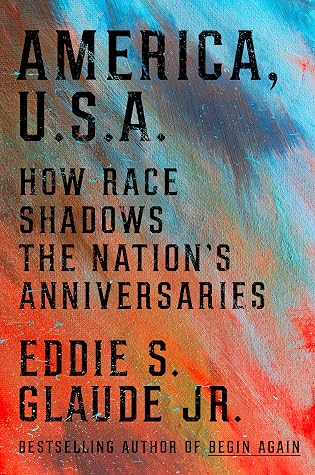
America, U.S.A.: How Race Shadows the Nation's Anniversaries
by

by
Eddie S. Glaude Jr. (Goodreads Author)
This book combines history, philosophy, and political critique to expose a "double consciousness" in the United States—an ongoing tension between viewing the country (1) as united on ideas of freedom, liberty, democracy, versus (2) as a republic rooted in racial hierarchy (i.e. White supremacy & Christian). By examining the status of racial conditions at various milestone anniversaries this book shows how the nation's uneven racial progress inevitably led to white rage and backlash.
These celebrations are perceived to be a time of self appraisal and reflection, but in reality the versions of history remembered at such times are the storybook versions free of blemish. This usually means ignoring the existence and contributions of racial minorities yielding a memory of white culture with black and brown life missing.
The 1876 centennial celebration occurred at crucial time in American history when post Civil War Reconstruction was losing momentum, white southerners were regaining political power, and northerners were tired of fighting old battles. Most historians generally date the end of Reconstruction to be a year later in 1877 when the role of federal troops in regional politics was reduced.
The 150th anniversary arrived in 1925 midst a resurgent Ku Klux Klan which was pushing for a more restrictive immigration law aimed at keeping America a "Nordic" nation. It's interesting to note that much of today's calls for reduction of immigration and removal of undocumented person's are eerily similar to the immigration law passed in 1924 that was very much inspired by the Ku Klux Klan.
Now in 2026 the author shares his despair by dismissing this year's Semiquincentennial as reaching back “to a storybook America that requires either the banishment of Black people from view or the reduction of our role in the country’s history, so as to affirm America’s ongoing quest to be a more perfect union.”
These celebrations are perceived to be a time of self appraisal and reflection, but in reality the versions of history remembered at such times are the storybook versions free of blemish. This usually means ignoring the existence and contributions of racial minorities yielding a memory of white culture with black and brown life missing.
The 1876 centennial celebration occurred at crucial time in American history when post Civil War Reconstruction was losing momentum, white southerners were regaining political power, and northerners were tired of fighting old battles. Most historians generally date the end of Reconstruction to be a year later in 1877 when the role of federal troops in regional politics was reduced.
The 150th anniversary arrived in 1925 midst a resurgent Ku Klux Klan which was pushing for a more restrictive immigration law aimed at keeping America a "Nordic" nation. It's interesting to note that much of today's calls for reduction of immigration and removal of undocumented person's are eerily similar to the immigration law passed in 1924 that was very much inspired by the Ku Klux Klan.
... quotas restricted entry into the country from southern eastern, and Central Europe—rejecting "the degraded races of Europe." Immigrants from the Pacific were effectively declared "ineligible to citizenship." (Donald Trump's reference to "shithole countries" has historical precedence after all.) This view shaped American immigration policy until Congress passed the Immigration and Nationality Act of 1965. In fact, though it is rarely explicitly stated, much of the political debate on the right around immigration today concerns repealing that 1965 legislation and returning to what we had in 1924—an immigration policy unquestionably shaped by the Ku Klux Klan. (p.122 of 271)The 1976 Bicentennial occurred after the resurgent 1960s civil rights era thus Black presence on the national scene could not be ignored as it had been in the past. However, it was perceived to be a malaise-ridden time following Vietnam, Watergate, and Nixon's resignation.
Now in 2026 the author shares his despair by dismissing this year's Semiquincentennial as reaching back “to a storybook America that requires either the banishment of Black people from view or the reduction of our role in the country’s history, so as to affirm America’s ongoing quest to be a more perfect union.”
- Get link
- X
- Other Apps


Comments
Post a Comment