
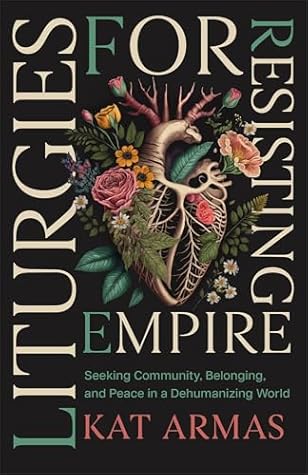
Each of the nine chapters that make up this book begin with an "Invocation" and a "Reflection," and each chapter ends with a "Benediction." In that regard this book contains liturgies as indicated by the book's title. However, the majority of the book's narrative addresses issues of empire in its multiple meanings and issues of "seeking community, belonging, and peace in a dehumanizing world" as stated in the book's subtitle.
The short liturgies help put the reader into an introspective and contemplative state of mind for considering the rest of the book's contents. The author uses the term "empire" in a metaphorical expanded sense that addresses many aspects of modern life, both religious and secular. Beginning with the traditional historical and political meanings of empire, the author expands her narrative to address lies, ideology, hierarchy, dualism, hustle, sameness, dominance, and violence (the previous series of words are taken from the chapter titles). The author also frequently uses the term "decolonize" to describe the act of removal or healing from the effects of empire.
The author shares bits of her spiritual journey by mentioning her experiences first with an evangelical megachurch and later attending seminary. She finds aspects of empire in both of those environments. (She refers to seminary as "belly of empire.")
This book's narrative seeks the powerless, in-between places, areas of ambiguity, and paradox. One of the comments by a Goodreads.com friend attached to this review says, "It sounds like she's holding on to the baby while throwing away the bathwater." I found that an apt description.
The rest of this review is made up of many quotations excerpted from the book. In the following I have made the chapter titles and section titles in bold font to distinguish them from the quotes.
Chapter 1. Rejecting Empire, Embracing Joy
Because when the earth groans so must we. Because speaking of peace and justice in a fractured world requires that we acknowledge the brokenness and the violence that continue to spread unchecked
Confronting the Theology of Empire
As Palestinian scholar Edward Said notes, empire isn't just soldiers and weapons; it's ideas, attitudes, practices, and stories.—It's a way of imagining the world
Only by acknowledging the Bible's complicity in violent ideologies and actions can we begin the work of addressing the injustices woven into its pages.
To interpret our own stories is to reclaim something sacred, to perform an act of resistance. The interpreter becomes the storyteller, the one who shapes their own history. But to be colonized is to be stripped of that power; it is to be erased from one's own story. This is part of empire's violence: seizing control of interpretation, rewriting the past to impose its own narrative on people's lives, land, and ancestors.
What Do We Mean by Empire, Anyway?
For many, empire is the villain—the tyrant, the oppressor, the force of destruction. But for those who've benefited from its rule, empire hasn't always been seen this way.
At its core, empire is about the relationship between a dominant, ruling state and a less powerful one.
Imperialism differs from empire in that it's less about the physical empire itself and more about the spirit of conquest behind it.
Untangling from Empire's Narratives
But that's the cunning of empire: It creates the very vulnerability it later claims to rescue you from.
This kingdom does not arrive with spectacle or force; it moves in unseen, quiet abundance through the ordinary. It breaks apart the illusions of power. It shatters our expectations.
I invite you to join me in this exploration, to examine our past and reclaim our present so that we can build a more just future. ... But this is the work of decolonizing. This is what healing looks like: Doing what we can, with what we have, in the capacity we're given.
Chapter 2. Rejecting Lies, Embracing Reality
I was beginning to realize the problem was not just an individual church or institution but the whole system. The weight of an empire in disguise was bearing down on everything, on all of us.
I was contorting myself into something I'm not in order to chase a hollow version of belonging. And I was doing so under the shadow of the modern evangelical empire—a culture that in many ways mirrors the way political empires at large have functioned: as a force so powerful it swallows many of us whole.
The Modern Evangelical Empire
In modern megachurches, pastors embody this kind of unchecked power, positioned as proxies for God—often without true accountability.
"How did we get here?" The answer, as you might suspect, lies in empire. ... As we'll explore throughout this book, much of the Bible—especially the New Testament—shows us what it means to follow Jesus and seek true belonging under the shadow of empire.
Skilled at the Facade
American culture has glorified conquest, downplaying the brutality of the European invasion of North America.
To confront this truth is not to discard the sacred but to reclaim it, to unravel the imperial threads woven into our faith and Christian identity and ask what remains. This is the first step toward liberation, toward a vision of God and community unbound by dominion.
An Imperial Imagination
The book of Revelation shows how deeply empire is etched into the imagination of the biblical authors.
Can we replace one dualistic empire with another and call it freedom? This paradox challenges us to reflect not just on the structures of past empires but on the spaces we attempt to create in response. Are they truly liberating, or do they quietly replicate the same dynamics of exclusion and hierarchy we claim to resist?
This way of thinking often reinforces the same binary structures inherent in empire. The oppressed are exalted, the oppressors disgraced. The hierarchy shifts, but it remains unbroken.
A Sanitized Incarnation
Empire's greatest strength is the illusion that it alone can save us, bring us peace, and offer us belonging, as long as we pledge allegiance to its ways.
Because the Bible is a book written by men, it shouldn't surprise us that the story of Christ's birth is told in ways that overlook the reality of childbirth.
Empire—both American and Christian—has mastered the art of selling us a facade. ... But when we take a close look at the birth of Jesus stripped of the filters, we're confronted with a truth that calls us to reject these false narratives. The holy angst we carry is not something to ignore but a sacred stirring. It must be named, lifted like a cry in the wilderness, so that we might unearth what is real...
You can't deconstruct something—you can't truly critique it—if you haven't lived it, if you haven't breathed it and felt it in all its com-plexity. I needed to immerse myself in all its glory to then be able to turn it on its head, to be able to see past the illusion.
3. Rejecting Ideology, Embracing Wisdom
What Decolonizing Isn't
I left the megachurch that year, though in my heart I had left long before. I thought seminary would be the antidote.
Stepping into the world of scholars and theologians with their "robust" and "legitimate" faith, I, as a Latina woman from a family who spoke broken English, discovered that I'd bought into the illusion.
Much of my coursework engaged post-colonial and decolonial thinkers who were disentangling academia from colonial ideology.
Decolonizing inherently includes hearing from a diversity of people, but the two are not synonymous. Decolonization is rooted in centuries of lived experiences, teachings, and perspectives that go beyond building a more diverse bookshelf.
The Journey of Unlearning
I consider it a grace and somewhat paradoxical that this journey began for me while in seminary, right in the belly of empire.
Because we've never known a world outside the grip of colonialism, patriarchy, and capitalism, we're going to spend our entire lives holding the tension between them and the world we hope for.
This is part of what I mean when I use the term decolonize: disconnecting from the status quo, from a theology that has been molded by empire, from a colonial Christ. And this journey isn't about "arriving" somewhere or "conquering" some ideal, for these very goals are remnants of colonial
thinking, aren't they?
As you can see, decolonization is a deeply personal process with many pathways to explore, the term itself carrying a wide range of definitions and approaches.
Academia, where Western thought has been passed down, taught, and protected, has been a primary vessel for empire's ideologies.
Making Room for Other Ways of Knowing
In many non-Western traditions, knowledge is as fluid as it is sacred. Here, knowing is not a concept but a way of moving and being in a world that insists wisdom lives as much in the soil and the wind as it does in human thoughts.
This embodied knowing is a call for the oppressed to voice their reality in their own language, without translation or dilution. It's a truth-telling that transcends divisions between Western science and Indigenous wisdom: two currents that, if allowed, can thrive together, honoring the distinct ways each understands life and creation. Only when these wisdoms move in harmony can we hope to build a world in the image of those who have been silenced, a world transformed by voices that carry truth from bone to breath.
Where Knowledge Becomes a Weapon
Through stories, empires controlled social narratives, solidifying their power to define and shape the way civilizations understood themselves.
What About the Bible?
... the Bible has long been entangled with empire's ambitions. Some even suggest that its very structure-the way it was gathered, ordered, and bound-bears the imprint of imperial influence.
Decolonizing the Bible isn't about replacing one interpretation with another or simply inverting the power dynamics we've inherited. It's about holding space for a mosaic of perspectives to coexist in tension, resisting the urge to tidy them into resolution. It's a refusal to demand that Scripture make us comfortable or certain.
Consider the contrast beween Ezra-Nehemiah and Ruth.
It is in these tensions and this nuance where the richness of wisdom emerges, not by erasing contradictions but by dwelling in them, by allowing new knowledge and understanding to take root.
Life Flourishes on the Edges
Life on the edge is more adaptive because it has to be. Species that learn to survive in environments that are ever-changing become the most creative.
Nature, our own experiences, and even Scripture confirm this truth: When we nurture these sacred in-between places—both spiritual and physical—we create opportunities for flourishing.
4. Rejecting Hierarchy, Embracing Kinship
American Family Hierarchy?
These small humans are discovering who they are—separate from us. And in that discovery, they're learning to trust, to explore, and to belong. Yet for those entrenched in theologies that prioritize control, this time of discovery can be seen as something to crush.
This is the kind of authority Jesus modeled, one rooted in tenderness, connection, and service. It's a vision that many evangelical leaders have missed in their pursuit of power, mistaking submission to human authority for faithfulness to God.
Not Your Father's Hierarchy
When Jesus speaks of greatness in the kingdom of God, he doesn't point to emperors or generals; he points to children. If our parenting and our relationships were built on that vision of power, then our
households would more clearly reflect the kingdom of God instead of the ways of empire.
... part of being fully human involves reckoning with the wounds inflicted by patriarchy, colonialism, and the rigid hierarchies that have shaped our families.
Few communities on Turtle Island carry the scars of colonization like Native populations, particularly the children who were torn from their families and cultures.
And in this history, we must reckon with the ways the church failed to protect the most vulnerable. This reckoning, however painful, is necessary if we are to seek any meaningful healing or reconciliation.
Racial Systems of Hierarchy
What makes racism so insidious is that it's so deeply embedded in the story of the West that it can feel impossible to imagine life without it.
The letter to Philemon is a reminder that interpretation is never free from bias. Whether it is seen as a story of reconciliation or a quiet endorsement of bondage depends entirely on what the reader brings to it.
A Kin-dom of Belonging
This kin-dom is God's liberation unfolding among us; it offers a table where all are welcomed and everyone belongs.
This is the way hierarchy works. Those with power think they get to delegitimize everyone else's ex-periences. And that's why part of my decolonizing work as a mother starts with the commitment to believe my daughter.
This is how we build a society rooted in kinship, a society where truth is honored and voices are believed.
5. Rejecting Dualism, Embracing Paradox
How Did We Get Here?
The split between mind and body, good and evil, and beauty and shame is a way of seeing the world that makes life feel neater, less uncertain. But in this ease, we sacrifice the vast spectrum that exists between extremes, and the richness of life's in-between.
But this wasn't just a theological shift; it was a political one that aligned religious authority and salvation with emerging ideas of individualism, nationhood, and power. Colonizers and revolutionaries saw themselves as defenders of liberty, believing it was their Christian duty to fight for the birth of a new nation. But their concept of liberty prioritized individual rights over collective responsibiliy.
Letting Our Light Shine?
I was captivated by this image of Jesus—the Word, the light—piercing through the dark.
I have always loved language, the way a single word can hold something so vast. But looking back, I see how these words in all their poetic beauty might have contributed to a way of seeing the world I am now trying to dismantle.
This binary mindset was weaponized to rationalize colonial and missionary efforts to bring
the "light of the gospel" to the so-called "heathen" in the non-Western world. 11 The darkness wasn't just metaphorical anymore—it represented a people, a geography, a skin. The Word became flesh, but in the hands of empire, the message became something that fractured us instead of knitting us together.
Ambivalence Sets Us Free
The illusion of certainty masquerades as spirituality, but the real stuff is found in the messy middle-in the ambiguity, the doubt, the ambivalence.
The Case for Harmony
The meeting ground between the self and the other need not be a battlefield, though that's how empires throughout history have framed it, often invoking the divine to justify their atrocities.
Here's where a profound paradox lies: The closer we get to Divine Light, the more clearly we see our own shadows, and this too is grace.
We are liberated when we're able to notice the stirrings of life happening inside us and out, and in the spaces in-between where we don't know to look.
6. Rejecting Hustle, Embracing Slowness
Empire has always been in the business of assigning value to differences, constructing systems around what it deems "ideal." But that ideal? It's always shifting in order to fit the needs of power.
The Colonized Body
Historically, white American policymakers have ignored the health of marginalized communities while using the resulting high rates of illness and death to justify dis-crimination, like segregation or immigration restrictions.
Blessed Are the Disabled
Large crowds followed him, the text says, and when he saw them, he went up a mountain and began to teach. This is the context behind Jesus's teaching, this crowd—the sick, disabled, and spiritually oppressed.
Ableism, like racism, sexism, heterosexism, classism, and all the other structures of violence that fracture our world, is a system that disadvantages groups of people with disabilities.
Ableism has been used as a tool for maintaining other forms of inequality, a way to strip dignity and worth from those who have always belonged. This is because at its core ableism is about more than disability. It's about who gets to be seen as fully human.
The Commodified Body
Empire tells us that the exploited bear the blame for their own suffering. Corporations insist that capitalism thrives because it's righteous, that inequality and devastation aren't failures but necessary costs. It's a comforting lie. But if we're honest, we know that every ounce of wealth in one hand is weighed by the loss in another. This is the truth we're called to face.
The Paradox of Wage Labor
Wage labor presents a paradox. There is, on the surface, freedom—the freedom to choose whom to work for, to step in and out of employment as one pleases. But beneath that thin veil of choice, capitalism makes it nearly impossible to survive without laboring for a paycheck.
I want to stop treating time like it's something slipping away and instead let it hold me. Freedom is learning how to dwell in the slowness, to breathe without the weight of scarcity pressing on my chest.
Time as Liberator
And maybe that's what decolonizing time looks like-freeing ourselves from the rush, the race, and learning to live in rhythm with the sacred cycles that have always been there, waiting for us to remember.
A Holy Pause
When Jesus invites the weary to come to him for rest, he's offering more than spiritual solace; he's also addressing the oppressive demands placed on their lives.
Reclaiming the Sacredness of the Body
Rest, then, is an act of trust. Trusting that we don't have to earn our place here. Trusting that we are enough, even when we are still.
If we are to reckon with our complicity in oppressive systems, we must turn inward and examine the quiet, unspoken ways we have learned to shrink, to resent, to war against our own flesh.
This is not just about individual transformation but also a commitment to fostering collective change.


Comments
Post a Comment