Reconstruction: The Unfinished Promise, by Malcolm Gladwell, Barack Obama
- Get link
- X
- Other Apps
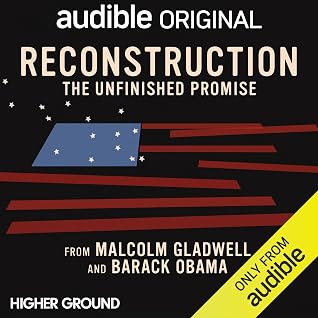
Reconstruction: The Unfinished Promise
by

by
Barack Obama (Goodreads Author),
Wyatt Cenac (Narrator),
Jelani Cobb (Narrator),
Kai Wright (Narrator),
Ashley C Ford (Narrator),
Manisha Sinha (Narrator),
more…This is an Audible audio edition which examines the post Civil War time commonly referred to as Reconstruction Era. The presentation is primarily the work of Malcom Gladwell who uses his story telling skills to provide a compelling story. The co-author credit indicated for Barack Obama is a marketing tactic to attract attention. I appreciated his involvement but it was limited and scattered. Obama does join into conversation with Gladwell at various points throughout the presentation, and his comments do add an interesting perspective, but there are many other scholars and researchers who also are part of this audio edition.
This audio work focuses on individuals who played important roles during the Reconstruction Era, and brings their quotations and testimonials to life by using professional narrators. I don't know how Fredrick Douglas' voice sounded in real life, but his narration in this work is how he should have sounded. I am still haunted by the testimonial of a victim of violence that is delivered in the voice of a black woman (in fifth chapter).
The following portion of this review consists of short descriptions of the contents found in the eight chapters of this audio edition.
The first chapter provides an introduction to the Reconstruction Era. It was a time of both hope and change. The 13th, 14th, and 15th Amendments were passed in relatively short period of time, and many modern rights are now based on those amendments.
The third chapter tells the story of to two women, one of whom served as a school teacher for the Freedman’s Bureau. The story is based upon correspondence between them and it does make reference to violence against the work of the Freedman’s Bureau, but I felt this section other than being an interesting story doesn’t add much to the subject of Reconstruction.
The fourth chapter is about nine black men who originally organized what eventually became Alabama State University. Its origin story had to be rediscovered, and it provides an example of the importance of eduction in the minds of the black population.
The fifth chapter describes some horrific stories about violence directed at the black population in the South. Apparently some whites couldn’t tolerate the thought of blacks owning and farming their own land.
The sixth chapter tells the story of Frederic Douglas’ involvement with the Freedman’s Bank. He was used by others in an effort to use his name to assure depositors that their money was safe. It wasn’t, and the bank failed. This incident tarnished Douglas' reputation.
The seventh chapter addresses the compromise of 1877 which resulted in the removal of federal troops from the South, effectively ending the Reconstruction Era. Gladwell asks the question, in light of the high cost of the Civil War that made possible the 13th, 14th, and 15th Amendments to the Constitution, how could the nation seem to forget all about that and let White supremacy have its day? Obama enters into the conversation again in this section and says that the country had other concerns, primarily economic.
The eighth chapter talks about how the history of the Reconstruction Era got completely turned around and was remembered in history books as a mistaken and failed effort. I liked this quotation which is a variation of the saying that the South won the peace.
This audio work focuses on individuals who played important roles during the Reconstruction Era, and brings their quotations and testimonials to life by using professional narrators. I don't know how Fredrick Douglas' voice sounded in real life, but his narration in this work is how he should have sounded. I am still haunted by the testimonial of a victim of violence that is delivered in the voice of a black woman (in fifth chapter).
The following portion of this review consists of short descriptions of the contents found in the eight chapters of this audio edition.
The first chapter provides an introduction to the Reconstruction Era. It was a time of both hope and change. The 13th, 14th, and 15th Amendments were passed in relatively short period of time, and many modern rights are now based on those amendments.
It's absolutely a new beginning for the United States. You want to understand rights in America? You gotta go to Reconstruction. You want to understand the role of government in society? Gotta go to Reconstruction. You want to talk about what governments owe their people, and what people owe their governments? You gotta go to Reconstruction. You want to talk about race in America? You gotta go to Reconstruction. To bring you this story, we dig through old archives, letters, diaries, court records, eyewitness testimony.Fredrick Douglas is the first individual discussed in the second chapter. He had been a well known abolitionist speaker prior the the Civil War, and after the war became a champion of freedmans' rights. Andrew Johnson is also covered in this chapter.
The third chapter tells the story of to two women, one of whom served as a school teacher for the Freedman’s Bureau. The story is based upon correspondence between them and it does make reference to violence against the work of the Freedman’s Bureau, but I felt this section other than being an interesting story doesn’t add much to the subject of Reconstruction.
The fourth chapter is about nine black men who originally organized what eventually became Alabama State University. Its origin story had to be rediscovered, and it provides an example of the importance of eduction in the minds of the black population.
The fifth chapter describes some horrific stories about violence directed at the black population in the South. Apparently some whites couldn’t tolerate the thought of blacks owning and farming their own land.
The sixth chapter tells the story of Frederic Douglas’ involvement with the Freedman’s Bank. He was used by others in an effort to use his name to assure depositors that their money was safe. It wasn’t, and the bank failed. This incident tarnished Douglas' reputation.
The seventh chapter addresses the compromise of 1877 which resulted in the removal of federal troops from the South, effectively ending the Reconstruction Era. Gladwell asks the question, in light of the high cost of the Civil War that made possible the 13th, 14th, and 15th Amendments to the Constitution, how could the nation seem to forget all about that and let White supremacy have its day? Obama enters into the conversation again in this section and says that the country had other concerns, primarily economic.
The eighth chapter talks about how the history of the Reconstruction Era got completely turned around and was remembered in history books as a mistaken and failed effort. I liked this quotation which is a variation of the saying that the South won the peace.
“… you could say the South lost the war, but won the historiography."The ninth and final chapter reviews how Reconstruction was remembered in popular culture through discussion of movies in particular.
- Get link
- X
- Other Apps


Comments
Post a Comment