The Editors, by Stephen Harrison
- Get link
- X
- Other Apps
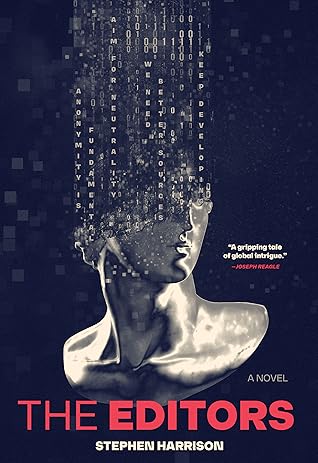
The Editors
by

by
Stephen Harrison (Goodreads Author)
There was a time in the past when I thought writing and editing Wikipedia articles might be a hobby that I might enjoy getting into. I did expand one author's biographic information and thought I would do more later, but as time passed I ended up focusing my spare time on reading and writing book reviews. I never went back to my Wikipedia account.
Thus when I came across this novel I thought it might be a way for me to learn about the life I missed. This book creates the world of Wikipedia editing and administration, but since it's a novel with a twinge of the the conspiratorial thriller genre, the author has decided to move farther toward fictionalization by using the term "Infopendium" as the name for the on-line encyclopedia.
A number of the Goodreads.com reviews of this book seem to agree that this book's description of the behind the scene battles that go on over controversial subjects is pretty realistic. There are political, business, and private interests that would like to present the truth in their preferred way. When this in-fighting gets too extreme an administrator has to step in to make a judgment call on what stays.
The principle rules followed in judging the content of articles written are:
The story narrated by the novel takes place from 2019 into 2020, so the evolving pandemic is an issue. Chinese interests want to downplay its seriousness, others want to accentuate the subject. One scene I found of interest was a librarian asking a patron why she was wearing a mask (pandemic news hadn't yet reached USA). The patron replied that she had a relative in Vietnam who told her about a pandemic. (i.e. Word of mouth news was spreading faster than official news.)
In an environment like this it's obvious that administrative editors who function as referees in disputes play an important role in settling disputes. The approval of who gets to be an administrator is voted on by other administrators and their candidacy is judged based on their past editing work. They are required to get seventy-five percent positive votes within a defined time in order to be approved. Campaigning is not allowed, but they are allowed to answer critical questions. One such election is portrayed in this book.
All this editing and voting is exciting, but this is a novel and needs dramatic action. Thus the plot develops into a stressful plot which evolves into a battle between the those on the good side and those on the bad side. A diehard advocate of old ways manages to hack Infopendium off line . A paid commercial competing on-line encyclopedia threatens to provide "better" truth. Feelings are intense, and a gun even gets pulled at one point. There's even a romance of sorts.
It's a pretty good story, so if you have any interest in a fictionalized view of what goes on behind the scenes at Wikipedia you might give this book a try.
Thus when I came across this novel I thought it might be a way for me to learn about the life I missed. This book creates the world of Wikipedia editing and administration, but since it's a novel with a twinge of the the conspiratorial thriller genre, the author has decided to move farther toward fictionalization by using the term "Infopendium" as the name for the on-line encyclopedia.
A number of the Goodreads.com reviews of this book seem to agree that this book's description of the behind the scene battles that go on over controversial subjects is pretty realistic. There are political, business, and private interests that would like to present the truth in their preferred way. When this in-fighting gets too extreme an administrator has to step in to make a judgment call on what stays.
The principle rules followed in judging the content of articles written are:
Aim for Neutrality.I knew the editing was open and volunteer, but I didn't realize that anonymity was an issue. In this book's narrative there are repeated instances when one editor submits an article (or edit) and another person recommends that it be subject to early deletion because of inadequate sources or lack of neutrality. Then other editors vote on whether it will be deleted or changed. Some editors with strong feelings of certain subjects would set up extra sock-puppet accounts to cast votes supporting their positions. Some editors sold their services to rich people to arrange to have their biographic data changed.
We Need Better Sources.
Anonymity is Fundamental.
Keep Developing.
The story narrated by the novel takes place from 2019 into 2020, so the evolving pandemic is an issue. Chinese interests want to downplay its seriousness, others want to accentuate the subject. One scene I found of interest was a librarian asking a patron why she was wearing a mask (pandemic news hadn't yet reached USA). The patron replied that she had a relative in Vietnam who told her about a pandemic. (i.e. Word of mouth news was spreading faster than official news.)
In an environment like this it's obvious that administrative editors who function as referees in disputes play an important role in settling disputes. The approval of who gets to be an administrator is voted on by other administrators and their candidacy is judged based on their past editing work. They are required to get seventy-five percent positive votes within a defined time in order to be approved. Campaigning is not allowed, but they are allowed to answer critical questions. One such election is portrayed in this book.
All this editing and voting is exciting, but this is a novel and needs dramatic action. Thus the plot develops into a stressful plot which evolves into a battle between the those on the good side and those on the bad side. A diehard advocate of old ways manages to hack Infopendium off line . A paid commercial competing on-line encyclopedia threatens to provide "better" truth. Feelings are intense, and a gun even gets pulled at one point. There's even a romance of sorts.
It's a pretty good story, so if you have any interest in a fictionalized view of what goes on behind the scenes at Wikipedia you might give this book a try.
- Get link
- X
- Other Apps


Comments
Post a Comment