The Great Miscalculation, by Michael M. Greenburg
- Get link
- X
- Other Apps
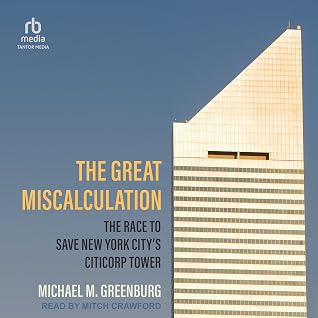
The Great Miscalculation: The Race to Save New York City's Citicorp Tower
by

by
Michael M. Greenburg (Goodreads Author),
Mitch Crawford (Narrator)
This book begins with this attention getting statement taken from a post-construction report:
The belated discovery of the problem was prompted by a telephone call and question from a design student to the chief designer, William LeMessurier. The question had a simple answer and was quickly answered, but it caused him to stop and think through the design concept. It occurred to him that because of its unique and unconventional framing that stresses from quartering winds might be different from stresses experienced from a wind direction 90° to face of building. Normally, any square or rectangular building designed to resist design wind forces 90° to its face will be strong enough to resist wind from any other direction. But the framing of this building transferred all load forces to four supporting columns located at the midpoints of the four sides, not the corners as is usually the case.
LeMessurier was pretty sure that forces caused by quartering winds had not been calculated because usually it's not needed. So he belatedly calculated those forces, and indeed stresses in the framing were different from those caused by 90° winds. Calculations showed that the framing itself had adequate strength except for a change that had been made during the shop drawing phase of the project. The steel fabricator offered a cost reduction if they were allowed to use bolted connections in the K-framing instead of fully welded. A bolted connection can develop the same strength as fully welded, but the number of bolts used in the as-built connections was based on the forces calculated using 90 winds. Thus the bracing connections as constructed were not adequate to resist forces caused by quartering winds. Calculations showed that a wind capable of toppling the building would have a 1-in-55 chance of occurring in an average year, or a 1-in-16 chance of happening if the tuned mass damper (TMD) on the roof was powered off.
Corrective action consisted of welding steel plates over the bolted joints at about 200 locations. The work was not publicized and because of the 1978 New York City newspaper strike it ended up not being widely known. Since no failure occurred the extent of the engineering crisis was only publicly revealed in a lengthy article in The New Yorker in 1995.
I am a retired licensed professional engineer, and since I was a structural engineer for some of my career I can say the following from personal experience. Finding a design flaw during or after construction is the second worst fear of a structural engineer; the worst fear is learning about the flaw after structural failure. The situation described in this book was corrected prior to failure thus has a happy ending, but the anguish of discovery and dealing with the crisis at the time makes for an interesting story as described by this book.
- The potential danger would not have been discovered.The above is referencing the construction in 1977 of the Citigroup Center, a skyscraper located in New York City. Construction had been completed and was already partly occupied when an error in design was discovered that indicated the structure could not withstand the wind force from a design storm (i.e. strong hurricane).
-LeMessurier might have shrunk from the horror of disclosure and gambled that the building would have somehow survived.
If either of these possibilities occurred it is certain as anything in the state of the art of engineering and mathematics that Citicorp Center had a one-hundred percent probability of total collapse by the end of the century. When collapse occurred it would have come suddenly without warning and would have killed thousands of people.
The belated discovery of the problem was prompted by a telephone call and question from a design student to the chief designer, William LeMessurier. The question had a simple answer and was quickly answered, but it caused him to stop and think through the design concept. It occurred to him that because of its unique and unconventional framing that stresses from quartering winds might be different from stresses experienced from a wind direction 90° to face of building. Normally, any square or rectangular building designed to resist design wind forces 90° to its face will be strong enough to resist wind from any other direction. But the framing of this building transferred all load forces to four supporting columns located at the midpoints of the four sides, not the corners as is usually the case.
LeMessurier was pretty sure that forces caused by quartering winds had not been calculated because usually it's not needed. So he belatedly calculated those forces, and indeed stresses in the framing were different from those caused by 90° winds. Calculations showed that the framing itself had adequate strength except for a change that had been made during the shop drawing phase of the project. The steel fabricator offered a cost reduction if they were allowed to use bolted connections in the K-framing instead of fully welded. A bolted connection can develop the same strength as fully welded, but the number of bolts used in the as-built connections was based on the forces calculated using 90 winds. Thus the bracing connections as constructed were not adequate to resist forces caused by quartering winds. Calculations showed that a wind capable of toppling the building would have a 1-in-55 chance of occurring in an average year, or a 1-in-16 chance of happening if the tuned mass damper (TMD) on the roof was powered off.
Corrective action consisted of welding steel plates over the bolted joints at about 200 locations. The work was not publicized and because of the 1978 New York City newspaper strike it ended up not being widely known. Since no failure occurred the extent of the engineering crisis was only publicly revealed in a lengthy article in The New Yorker in 1995.
I am a retired licensed professional engineer, and since I was a structural engineer for some of my career I can say the following from personal experience. Finding a design flaw during or after construction is the second worst fear of a structural engineer; the worst fear is learning about the flaw after structural failure. The situation described in this book was corrected prior to failure thus has a happy ending, but the anguish of discovery and dealing with the crisis at the time makes for an interesting story as described by this book.
- Get link
- X
- Other Apps


Comments
Post a Comment