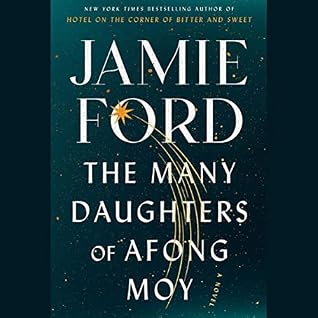
The Many Daughters of Afong Moy, by Jamie Ford
- Get link
- X
- Other Apps
The Many Daughters of Afong Moy
by

by
Jamie Ford (Goodreads Author),
Jennifer Lim (Narrator),
Mirai (Narrator),
Cindy Kay (Narrator),
Sura Siu (Narrator),
Nancy Wu (Narrator)
This novel presents a story of seven generations of women stretching over two hundred fifty years going from 1836 on to the future year 2086. At first the reader is presented with scattered vignettes in nonlinear chronological order much as a series of short stories. As one progresses through the stories it gradually becomes apparent that these stories are all about women who are, as hinted by the book’s title, descendants of Afong Moy. Afong Moy was an actual historical person, the first woman of Chinese ancestry to immigrate to the United States.
The author of this book has imagined subsequent generations of Afong Moy to illustrate examples of the epigenetic effects of repeated trauma which can be inherited by later generations. The zig-zag trajectory of this book’s narrative eventually focuses on Dorothy Moy who undergoes epigenetic therapy in Seattle in 2045. Neuroscience and psychiatry have advanced by that date such that it enables Dorothy to change her inherited memories. The effects of these inherited generational memories had imposed a variety of mental health issues upon her life, and she knows that if she does nothing about it they will be passed on to her daughter who has been showing early behaviors and visions similar to her own.
Thus near the end of this book, in a rather dramatic fashion of being close to death, Dorothy travels through a sequence of visions that appear to be traveling into the past to make corrections to past trauma that afflicted her predecessors. In three of the scenes she visits the place in the story line that duplicates the same beginning portions of the narrative that occurred previously in the book. In those scenes the reader knows exactly what changes she makes because the book’s reader has previously read the original version. One of the visits is to a different point in the timeline from what was described earlier in the book, so it's unclear what change was made if any. In another visit she is a third party witness to a previously described scene rather than embodying her ancestor.
The trauma descriptions earlier in the book are quite unsettling. Thus these changes made to inherited past traumas came as a great relief to me as a reader of the book in addition to what must have been experienced by the fictional Dorothy character. I am taking the position that in all these visits to the past, she changed memories, not past history; that way it keeps the book out of the time travel genre. However, there are other ways to interpret the book.
There is an active debate among scientists about how much epigenetics can explain examples of what appears to be inherited memories. This author has taken those possibilities to what I think is an unrealistic extreme in this novel. However, I’ll admit it makes for an interesting story. It offers a biological explanation for being haunted by ancestors' trauma.
The spoiler below contains notes to myself for reference when I meet with a book group to discuss this book. It lists names of the daughters and dates covered by this book.
[
Afong Moy (1836)
The dates shown above are the time of the story told in book. Except for Annabel and Faye, all daughters were separated from mother at young age. The reason the date for Zoe occurs prior to the date for Faye is because story of Zoe is when she was teenager, whereas the story of Faye occurs when she is in her 50s. Faye had given birth to Zoe as a teenager, thus given her away for adoption.
The author of this book has imagined subsequent generations of Afong Moy to illustrate examples of the epigenetic effects of repeated trauma which can be inherited by later generations. The zig-zag trajectory of this book’s narrative eventually focuses on Dorothy Moy who undergoes epigenetic therapy in Seattle in 2045. Neuroscience and psychiatry have advanced by that date such that it enables Dorothy to change her inherited memories. The effects of these inherited generational memories had imposed a variety of mental health issues upon her life, and she knows that if she does nothing about it they will be passed on to her daughter who has been showing early behaviors and visions similar to her own.
Thus near the end of this book, in a rather dramatic fashion of being close to death, Dorothy travels through a sequence of visions that appear to be traveling into the past to make corrections to past trauma that afflicted her predecessors. In three of the scenes she visits the place in the story line that duplicates the same beginning portions of the narrative that occurred previously in the book. In those scenes the reader knows exactly what changes she makes because the book’s reader has previously read the original version. One of the visits is to a different point in the timeline from what was described earlier in the book, so it's unclear what change was made if any. In another visit she is a third party witness to a previously described scene rather than embodying her ancestor.
The trauma descriptions earlier in the book are quite unsettling. Thus these changes made to inherited past traumas came as a great relief to me as a reader of the book in addition to what must have been experienced by the fictional Dorothy character. I am taking the position that in all these visits to the past, she changed memories, not past history; that way it keeps the book out of the time travel genre. However, there are other ways to interpret the book.
There is an active debate among scientists about how much epigenetics can explain examples of what appears to be inherited memories. This author has taken those possibilities to what I think is an unrealistic extreme in this novel. However, I’ll admit it makes for an interesting story. It offers a biological explanation for being haunted by ancestors' trauma.
The spoiler below contains notes to myself for reference when I meet with a book group to discuss this book. It lists names of the daughters and dates covered by this book.
[
Afong Moy (1836)
First Chinese woman to USA. Worked as spectacle/entertainer. Died homeless while giving birth to son.Son of Afong, father of Lai King (no date)
Raised by mission home in San Francisco, California.Lai King Moy (1892)
Child in San Francisco, is sent back to China alone as a child.Fei-jin "Faye" Moy (1942)
Chinese nurse during WWII, learned to speak English from mother, met American pilot John Garland who dies.Zoe Moy (1927)
Adopted by wealthy family, sent to private school in England, scandalized by publicized lesbian love note to teacher.Son of Zoe, father of Greta (no date)
I missed this generation, a book group friend informed me of it.Margaret "Greta" Moy (2014)
Computer programer of successful dating app, lives in Seattle, scandalized by publicized photo with wealthy investorDorothy Moy (2045)
Poet with mental health struggles, visits inherited memories via experimental drug.Annabel (2086)
Becomes poet like her mother, free of problematic inherited memories.Note:
The dates shown above are the time of the story told in book. Except for Annabel and Faye, all daughters were separated from mother at young age. The reason the date for Zoe occurs prior to the date for Faye is because story of Zoe is when she was teenager, whereas the story of Faye occurs when she is in her 50s. Faye had given birth to Zoe as a teenager, thus given her away for adoption.
- Get link
- X
- Other Apps


Comments
Post a Comment